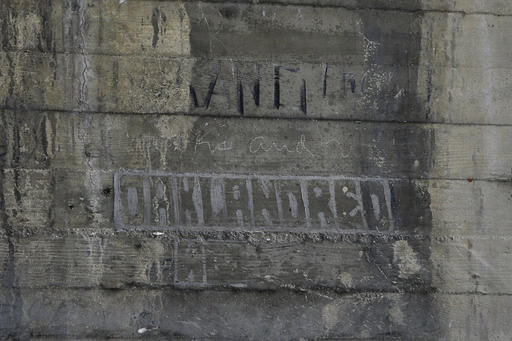
"Anthropologist Susan Phillips had spent a career examining the graffiti that covers urban walls, bridges and freeway overpasses.
Phillips had uncovered a peculiar, almost extinct form of American
hieroglyphics known as hobo graffiti, the treasure trove discovered
under a nondescript, 103-year-old bridge spanning the Los Angeles River.
At the time, she was researching her book, "Wallbangin': Graffiti and
Gangs in LA."
"It was like opening a tomb that's been closed for
80 years," the Pitzer College professor of environmental analysis said
of finding the writings and occasionally the drawings of people who once
signed their names as Oakland Red, the Tucson Kid and A-No. 1.
"There's
an A-No. 1, dated 8/13/14," she said, pointing to a scribbling during a
recent visit to the bridge just around the bend from a modern-day
homeless encampment.
Although all but forgotten now, A-No. 1 was
the moniker used by a man once arguably America's most famous hobo, one
of the many itinerant wanderers who traveled from town to town in the
19th and 20th centuries, often by freight train, in search of brief work
and lasting adventure.
Read rest here
Sunday, June 5, 2016
Saturday, May 28, 2016
Dumbfoundead - Safe
Reacting to the politics of asian-american representation
Tuesday, May 24, 2016
Tuesday, April 26, 2016
Friday, March 18, 2016
Art in the Streets
"Street artists engage in activism in a unique way: by moving their art out of the museum and into ordinary life, street artists do not merely comment about the state of the world; they intervene and change our world with their works. Inserting art directly into the real world (not the artworld) allows street artists to actively construct a different world to inhabit. Street art is designed to cross the boundary between art and an actual act of protest – that is its point!
This activism is made possible because of its aconsensual methods of production. No matter what style, medium, or political agenda, all street art is made without consent of the property owner. This aconsensuality transforms the art-making process into an act of
political and social protest. It is the umbrella concept under which the diverse facets of street art come together into a single, unified group that does justice to the social, political, intersectional, environmental and legal aspects of street art.
Street art is a sign of the times – where consumerism has become a forced way of life, where the artworld’s institutional pressures suffocate emerging artists, and where marginalised artists struggle to make their voice heard, street art represents an unexpected opportunity to opt out of the artworld system altogether. But these artists are not going underground; they are taking to the streets! There, they have the freedom to create their own art, in their own style, on their own terms. Street art presents a new alternative path for artists – one that allows them a chance for authentic expression, an opportunity to develop a set of alternative customs, traditions and norms that operate alongside, but definitely far away from, the “official” code articulated in art schools. The street is a logical escape from it all."
read more here
by Dr. Sondra Bacharach, Victoria University of Wellingtom
This activism is made possible because of its aconsensual methods of production. No matter what style, medium, or political agenda, all street art is made without consent of the property owner. This aconsensuality transforms the art-making process into an act of
political and social protest. It is the umbrella concept under which the diverse facets of street art come together into a single, unified group that does justice to the social, political, intersectional, environmental and legal aspects of street art.
Street art is a sign of the times – where consumerism has become a forced way of life, where the artworld’s institutional pressures suffocate emerging artists, and where marginalised artists struggle to make their voice heard, street art represents an unexpected opportunity to opt out of the artworld system altogether. But these artists are not going underground; they are taking to the streets! There, they have the freedom to create their own art, in their own style, on their own terms. Street art presents a new alternative path for artists – one that allows them a chance for authentic expression, an opportunity to develop a set of alternative customs, traditions and norms that operate alongside, but definitely far away from, the “official” code articulated in art schools. The street is a logical escape from it all."
read more here
by Dr. Sondra Bacharach, Victoria University of Wellingtom
J Pink
Futuristic
Futuristic...We see you Koreacredit: 제이핑크 & 핑키칙스 - J Pink & Pinky Cheeks
Posted by Illegal Musik on Saturday, March 5, 2016
Wednesday, February 17, 2016
Sunday, January 31, 2016
Monday, January 25, 2016
Sunday, January 10, 2016
Friday, January 8, 2016
Thursday, January 7, 2016
Canadian Indigenous Hip Hop: First Ladies
Even within the aboriginal hip hop community, there was some initial reticence to softer female voices talking about hard issues—and
skepticism about their skills. ”Hip hop in general is a man’s world,”
says Christie Lee Charles. “So it was hard as indigenous women,
especially as young indigenous women.” But in the last few years, the
First Ladies Crew members have been gaining notice both within and
outside of their aboriginal communities as part of an uprising. Their
audiences are bearing witness to the traditional sharing of aboriginal
oral history through new music.
“We
aren’t just rappers, we aren’t just MCs,” says Charles. “It’s not just
us telling our stories. I am not just up there [on stage] spitting an
ill verse. I am up there sharing our oral history.”
The
First Ladies are encountering an interesting time on Canada’s timeline:
Past wrongs against the nation’s aboriginals are being more openly
acknowledged. For years, indigenous children in Canada were taught to deny their culture through a residential school system. The last residential school closed only a decade ago and, after a five-year inquiry, the process was deemed “cultural genocide” in 2015. Further, voters and activists have called on the Canadian government to address the thousands of indigenous women who have gone missing or been found murdered over the last decade. (The newly elected government under Prime Minister Justin Trudeau has promised an inquiry.)
...
The
empowerment of the First Ladies is deeply rooted in the matrilineal
nature of indigenous culture. “For me, JB the First Lady is bringing
First Ladyship back to the rightful owners: indigenous women of Turtle
Island,” said Webster. She speaks in reference to the role of aboriginal
women in traditional politics and society and the legend about the
creation of the earth by a female figure. “Not the queen, not the
president’s wife, but indigenous women. That’s my name and that’s what I
want to bring forward.”
Subscribe to:
Posts (Atom)