"The
demands of the "black" middle class are not the demands of those that
occupy the public imagination as criminals and drug dealers. I do not
believe that people think that the public intellectual Ekow Eshon is a
criminal or that Oxford educated UCL academic Nathaniel Coleman is
styled as a gang leader on a regular basis or Cambridge educated lawyer
Kevin Bismark Cobham considered a coke dealer. I do not believe that
they are excluded from consumption; so they struggle to speak to this
politics. I appreciate that they have risen to the highest levels but I
don't think that an excellent education alone makes one a credible voice
on the issues that those in the "black" poor experience. I do not
believe that left-wing academic conversations about "structural racism"
do anything but add some nice theories to the canon of left-wing thought
to sit on the shelf so the next generation of "race" men can sit down
and pontificate on them; in libraries, lecture halls and at
Pan-Africanist intellectual gatherings.
The
urban "underclass" need politics and policy that is realistic and
improves their day to day lives like the raising of the threshold on
personal allowance; prison reform; legalisation of cannabis and
decriminalisation of drugs; an overhaul of stop and search; funding for
legal aid; mental health funding; large scale investment in social
housing; digital inclusion and living wage jobs in our inner cities. We
are not interested in another ideological; theoretical fairytale but
some intelligent policy that tackles the issues rather than a simplistic
request for positive action that will fundamentally expand the gap.
"Race" politics is the home of the "black" middle class and not those
down to earth folk struggling on the breadline from one day to the next."
Read the full article here
Showing posts with label commentary. Show all posts
Showing posts with label commentary. Show all posts
Sunday, January 15, 2017

Wednesday, January 4, 2017
From Du Bois to Lamar
“Lock our bodies but can’t trap our minds!” he would shout later, jumping freely around the stage. “Trap our bodies but can’t lock our minds!”
Lamar launched into a searing attack, rapping the entire first verse of his song “The Blacker the Berry,” the subtext of each shared lyric making clear the otherwise unnamed object of his rage: white supremacy. And in those moments, when Lamar first spoke, between the force of the words and the force of the beat, his entire body jolted as if struck by lightning, as if lit up with a police Taser, as if volts of force rushed through him, froze him in place, then rushed through him again. This, too, orchestrated to reveal the deeper meaning of his lyrics to come: that the secondary status of black bodies is comprehensive, exhaustive, systematic, shocking one’s entire system, jolting, seizing.
The deeper meaning of the lyrics to come—their subtext played out by the drama on the stage—is part of a rich tradition, the continuance of a conversation with some of the earliest black protest writers.
That’s a lot to unpack: disillusionment and resolve; countering
negative messaging about black bodies and heritage; acute awareness of
racial hatred against black life and culture; threats of vengeful action
arising from the pressures of racial prejudice; recognizing the
calculated hand of systematic racism in the destruction of black
communities… A lot under that hood for sure.
...
This lineage predates black protest writer W.E.B. Du Bois’s loosely linked essays in The Souls of Black Folk, but that is where I first began digging all those months ago. Though subtext permeates Du Bois’s collection, it’s in the short story “Of the Coming of John”—the tale of two Johns, childhood friends from a rural Southern town, one white, one black—that the sub-textual tricks are especially powerful. Both characters are going to college, celebrated and encouraged by their families, but the whites of the town discourage the education of black John.
“It’ll spoil him, – ruin him,” they said. “And they talked as though they knew,” Du Bois, the narrator of this sole fictional piece in the book, tells us.
The blacks of the town are so excited that “full half the black folk followed [their black John] proudly to the station, and carried his queer little trunk and many bundles. And there they shook and shook hands, and the girls kissed him shyly and the boys clapped him on the back.”
But, as the whites of the town, proud of their white John and all his possibilities (perhaps he can return and become governor, or mayor, or something more), shake their heads at the foolishness of the black excitement about the black John, the blacks cannot contain their excitement about their John’s eventual return.
read the rest here
Lamar launched into a searing attack, rapping the entire first verse of his song “The Blacker the Berry,” the subtext of each shared lyric making clear the otherwise unnamed object of his rage: white supremacy. And in those moments, when Lamar first spoke, between the force of the words and the force of the beat, his entire body jolted as if struck by lightning, as if lit up with a police Taser, as if volts of force rushed through him, froze him in place, then rushed through him again. This, too, orchestrated to reveal the deeper meaning of his lyrics to come: that the secondary status of black bodies is comprehensive, exhaustive, systematic, shocking one’s entire system, jolting, seizing.
The deeper meaning of the lyrics to come—their subtext played out by the drama on the stage—is part of a rich tradition, the continuance of a conversation with some of the earliest black protest writers.
Been feeling this way since I was 16, came to my senses
You never liked us anyway, fuck your friendship, I meant it
I’m African-American, I’m African
I’m black as the moon, heritage of a small village
Pardon my residence
Came from the bottom of mankind
My hair is nappy, my dick is big, my nose is round and wide
You hate me don’t you?
You hate my people, your plan is to terminate my culture
You’re fuckin’ evil I want you to recognize that I’m a proud monkey
You vandalize my perception but can’t take style from me
And this is more than confession
I mean I might press the button just so you know my discretion
I’m guardin’ my feelings, I know that you feel it
You sabotage my community, makin’ a killin’
You made me a killer, emancipation of a real nigga [1]
...
This lineage predates black protest writer W.E.B. Du Bois’s loosely linked essays in The Souls of Black Folk, but that is where I first began digging all those months ago. Though subtext permeates Du Bois’s collection, it’s in the short story “Of the Coming of John”—the tale of two Johns, childhood friends from a rural Southern town, one white, one black—that the sub-textual tricks are especially powerful. Both characters are going to college, celebrated and encouraged by their families, but the whites of the town discourage the education of black John.
“It’ll spoil him, – ruin him,” they said. “And they talked as though they knew,” Du Bois, the narrator of this sole fictional piece in the book, tells us.
The blacks of the town are so excited that “full half the black folk followed [their black John] proudly to the station, and carried his queer little trunk and many bundles. And there they shook and shook hands, and the girls kissed him shyly and the boys clapped him on the back.”
But, as the whites of the town, proud of their white John and all his possibilities (perhaps he can return and become governor, or mayor, or something more), shake their heads at the foolishness of the black excitement about the black John, the blacks cannot contain their excitement about their John’s eventual return.
read the rest here
Saturday, December 3, 2016
Exile
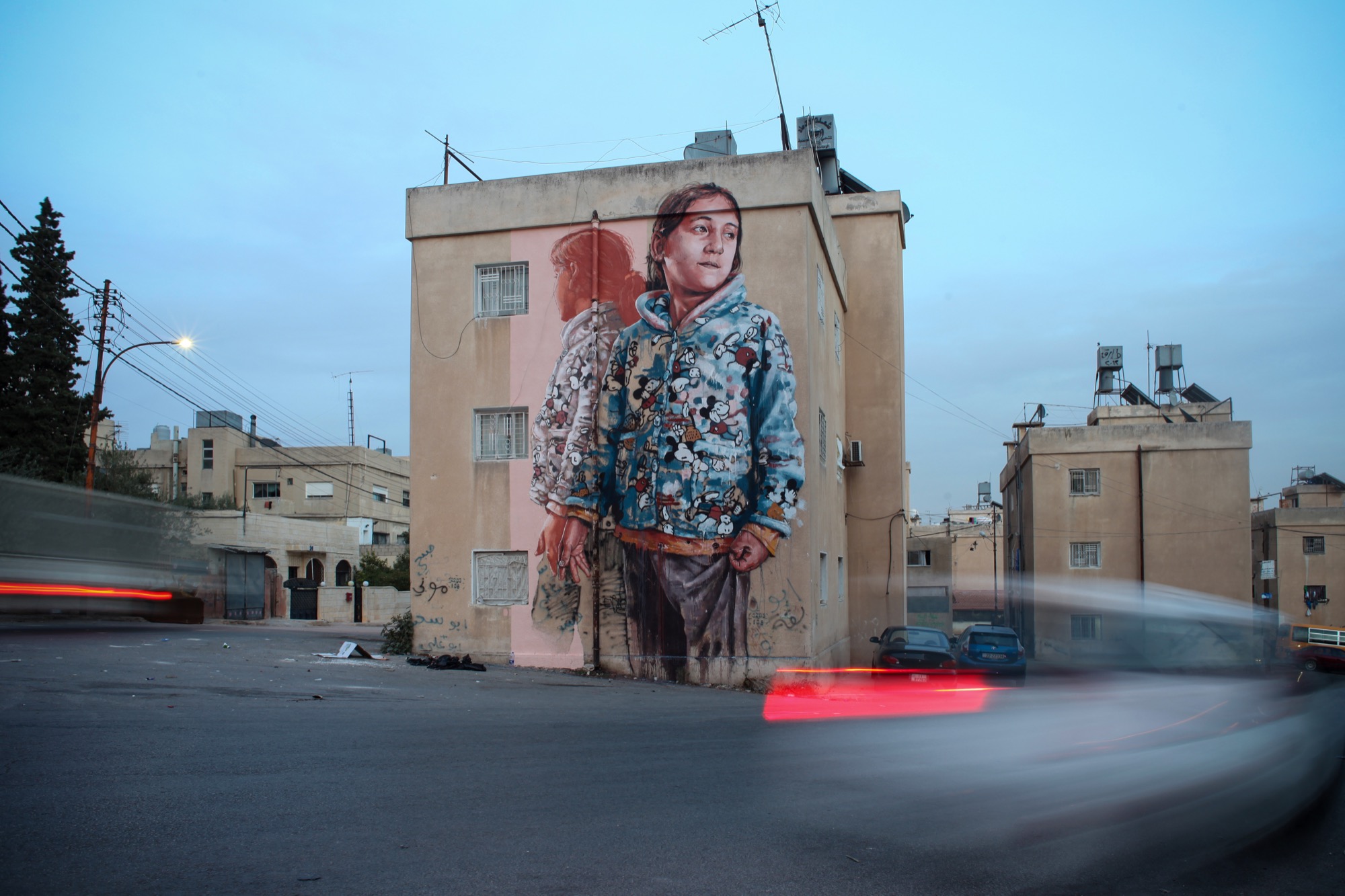
"Inside Azraq Refugee camp there is a space for children who arrive without their parents. All the stories are different. Some children lost their parents in the war, others lost them in transit across the border and some have parents than can not or no longer wish to care for them. The kids stay in a specific space that is an orphanage of sorts. They are not permitted to leave this space until they are either 18 or they are reunified with their parents. The space is in the desert camp with stark white pre-fabricated containers. Together with Fintan Magee, Jordanian artist Suhaib Attar and the kids, they painted their space. AptArt covered every bit of white space with colour."
read the rest here
Sunday, September 11, 2016
Thursday, September 8, 2016
Monday, September 5, 2016
Monday, August 8, 2016
Brazilian Hip Hop; "Turn Down for What"
"In Brazil noise has also gained local nuances around struggle. For
those interested in the legacy of anti-government protest, both from the
left and right, in the Southern Cone, there has been a resurgence of
the panelaço
(the piercing, incessant battering of the frying pan) in the last two
years in urban Brazil with particular vigor over the past weeks. This
noise marks a specific articulation; it is superficial to the long
history and deep stigma that barulho (noise) carries in Brazil. In a recent post, São Paulo sarau (open microphone events) organizations issued a manifesto called #PeriferiasContraOGolpe,
loosely translated as “The Periphery against the Coup,” in which they
use noise as an existential position of interlocution rather than a
simple sign of opposition.
We the residents of the periphery, who never slept as the so-called giant slept, are here to send a noisy, resonant salve to the fascists: we are against the coup d’état currently in motion, one that would affect us directly!
...
Sérgio Vaz, a leading sarau organizer, writes in his poem “A Mutt of Literature”:
http://www.anthropology-news.org/index.php/2016/08/03/turn-down-for-what/
We the residents of the periphery, who never slept as the so-called giant slept, are here to send a noisy, resonant salve to the fascists: we are against the coup d’état currently in motion, one that would affect us directly!
...
Sérgio Vaz, a leading sarau organizer, writes in his poem “A Mutt of Literature”:
You say you don’t understand
This noise that comes from streets
Don’t understand this voice
That walks with rock in hand
In search of justice, if not revenge…
We are the ones who scream,
Those without education, hospitals, w/o security
We are the orphans of the fatherland
The bastard children of the nation…
http://www.anthropology-news.org/index.php/2016/08/03/turn-down-for-what/
Thursday, August 4, 2016
Hip Hop in response to gang violence
"Project Blowed was also more than just a lyrical training ground. It was a sanctuary for young men growing up in the shadows of Crips and Bloods gang violence. Big Flossy had grown up affiliated with the Rollin’ 40s. As a young man, he got jumped into the gang and identified as a gang member. But things changed once he got serious about hip hop. Once, while reflecting on his life, he said: ‘I was young and dumb back then. Just on some stupid shit. These days, I try to keep it moving – try to do something positive because this music is everything.’"
read here
read here
Thursday, July 21, 2016
Underground White Rappers' Hegemonic Masculinity and Racial Evasion
By: Matthew Oware
Abstract:
Employing the concept of racial evasion—a derivation of Bonilla-Silva’s colorblind ideology theory—the author analyzes 237 songs of underground white and nonwhite rappers from 2006 to 2010. Performing a content analysis on their lyrics, the author finds that white artists make fewer references to racially political and social themes (e.g., racial profiling, police brutality, racist policies) than nonwhite artists—what the author terms racial evasion. The author speculates that white rappers, understanding that they operate in a specifically racialized black and brown cultural art form, deemphasize or mask their racial identity in their lyrics. This tactic is achieved through lyrically referencing hypermasculine tropes such as violence, misogyny, and homophobia to a greater degree than nonwhite artists. This work demonstrates the strategic use of hypermasculine discourse as a rhetorical strategy to achieve “hip hop authenticity” by minimizing or evading racial discourse within this popular cultural form. Furthermore, the author illustrates how the maintenance and manifestation of white male privilege operates via the process of deracialization as a form of meaning making. Ultimately, this work elaborates on the debate of “authenticity” within hip hop studies, providing a window into white racial identity construction within popular culture.
Full article here
Abstract:
Employing the concept of racial evasion—a derivation of Bonilla-Silva’s colorblind ideology theory—the author analyzes 237 songs of underground white and nonwhite rappers from 2006 to 2010. Performing a content analysis on their lyrics, the author finds that white artists make fewer references to racially political and social themes (e.g., racial profiling, police brutality, racist policies) than nonwhite artists—what the author terms racial evasion. The author speculates that white rappers, understanding that they operate in a specifically racialized black and brown cultural art form, deemphasize or mask their racial identity in their lyrics. This tactic is achieved through lyrically referencing hypermasculine tropes such as violence, misogyny, and homophobia to a greater degree than nonwhite artists. This work demonstrates the strategic use of hypermasculine discourse as a rhetorical strategy to achieve “hip hop authenticity” by minimizing or evading racial discourse within this popular cultural form. Furthermore, the author illustrates how the maintenance and manifestation of white male privilege operates via the process of deracialization as a form of meaning making. Ultimately, this work elaborates on the debate of “authenticity” within hip hop studies, providing a window into white racial identity construction within popular culture.
Full article here
Graffiti and Political Possibility in Athens, Greece
By: Othon Alexandrakis
Abstract:
Based on field research in Athens, Greece, this essay considers graffiti as a mode of political response to the material and symbolic violences of neoliberal governmentality. In 2010, the Greek state declared sovereign debt crisis and began to implement an aggressive austerity program in exchange for economic aid from a troika of international lenders. This resulted in the dismantling of public services, tax increases, salary and pension reductions, layoffs, and, generally, the impoverishment of the middle and lower classes. In this work I consider a crew of three young graffiti writers, both before and during the years of the crisis, as they came to realize a fear of becoming integrated into an economized social mainstream and responded by creating street art intended to bolster critical reasoning among Athenians. I argue that fear of abjection and the experience of being at the social margins served as a stimulus of critical agency, and that the crew’s intervention can be considered indirect activism: a mode of resistance whose critical agents attempt to bring about their ambitions and visions by activating other groups to undertake resistance of their own. I show how my interlocutors made political possibility by creating art that lessened the capacity of neoliberal governmentality to manufacture consent, thereby contributing to a thriving ecology of resistance action in Athens.
Read full article here
Abstract:
Based on field research in Athens, Greece, this essay considers graffiti as a mode of political response to the material and symbolic violences of neoliberal governmentality. In 2010, the Greek state declared sovereign debt crisis and began to implement an aggressive austerity program in exchange for economic aid from a troika of international lenders. This resulted in the dismantling of public services, tax increases, salary and pension reductions, layoffs, and, generally, the impoverishment of the middle and lower classes. In this work I consider a crew of three young graffiti writers, both before and during the years of the crisis, as they came to realize a fear of becoming integrated into an economized social mainstream and responded by creating street art intended to bolster critical reasoning among Athenians. I argue that fear of abjection and the experience of being at the social margins served as a stimulus of critical agency, and that the crew’s intervention can be considered indirect activism: a mode of resistance whose critical agents attempt to bring about their ambitions and visions by activating other groups to undertake resistance of their own. I show how my interlocutors made political possibility by creating art that lessened the capacity of neoliberal governmentality to manufacture consent, thereby contributing to a thriving ecology of resistance action in Athens.
Read full article here
Monday, July 18, 2016
Joe Budden Freedom Freestyle
Budden:
"I was told there was once a world where slaves communicated with each other via music, and tho I wasn’t present for that, the Hip Hop I fell in love with always encouraged me to do the same (Thank you Public Enemy)…. Let this act as an unfortunate reminder that times change and they don’t. #BlackLivesMatter #YallLivesMatter #OurLivesMatter … I’m afraid to wonder what happens when we as a ppl decide to stop saying it. Some deem us threatening now by sheer design. We are not. We are loving, passionate, cultured and proud, even during unrest. However, with every life viciously and maliciously taken by costumed evil, we grow more and more afraid. What will occur when too many of us are afraid? #IfYouDontValueMyLifeEYEWill #GodHelpUsAll #TheMissionIsGreat"
source
"I was told there was once a world where slaves communicated with each other via music, and tho I wasn’t present for that, the Hip Hop I fell in love with always encouraged me to do the same (Thank you Public Enemy)…. Let this act as an unfortunate reminder that times change and they don’t. #BlackLivesMatter #YallLivesMatter #OurLivesMatter … I’m afraid to wonder what happens when we as a ppl decide to stop saying it. Some deem us threatening now by sheer design. We are not. We are loving, passionate, cultured and proud, even during unrest. However, with every life viciously and maliciously taken by costumed evil, we grow more and more afraid. What will occur when too many of us are afraid? #IfYouDontValueMyLifeEYEWill #GodHelpUsAll #TheMissionIsGreat"
source
Sunday, July 17, 2016
Wednesday, July 13, 2016
Korea's acceptance of breakdancing
"Wing got his big break after winning first place at the prestigious Red
Bull BC One competition in Paris in 2008. Then in 2010, Jinjo Crew went
on to win the Battle of the Year competition. They emerged as one of the
hottest B-boy crews in the world and continued to win at major
competitions across the globe.
Since then, the B-boy craze in Korea has skyrocketed. It is now not only a well-recognized type of dance, but a popular form of entertainment enjoyed by both younger and older audiences, attracting local and international spectators alike.
Today, there are countless nonverbal plays featuring interludes of break dancing and even plots based entirely on B-boying, including shows like “Ballerina Who Loved a B-Boy,” “Jump,” “B-boy Musical Marionette” and the popular “B-boy Kung,” the only B-boy musical in the world to have an exclusive theater.
“I can’t even begin to explain the huge boom in the B-boy movement in Korea over the past several years,” Wing said. “The B-boying culture has become so popular in Korea that even many senior citizens here have heard of it and know what it is, which was unthinkable to me years ago.”
“Even though break dancing was invented by Western dance crews, Asian B-boys have created a reputation for elevating the level and complexity of the dance moves,” he added. “Something about our body type allows us to make for the ideal B-boy dancers.”
The country continues to make great strides in promoting local break dancing and creating an internationally recognized reputation for its pool of talented B-boys and fiercely competitive dance crews.
Capitalizing on the dance form’s substantial popularity here, the Korean government established in 2007 the R-16 Korea, an annual international B-boy competition hosted by the Korea Tourism Organization and the Ministry of Culture, Sports and Tourism."
read rest here
Since then, the B-boy craze in Korea has skyrocketed. It is now not only a well-recognized type of dance, but a popular form of entertainment enjoyed by both younger and older audiences, attracting local and international spectators alike.
Today, there are countless nonverbal plays featuring interludes of break dancing and even plots based entirely on B-boying, including shows like “Ballerina Who Loved a B-Boy,” “Jump,” “B-boy Musical Marionette” and the popular “B-boy Kung,” the only B-boy musical in the world to have an exclusive theater.
“I can’t even begin to explain the huge boom in the B-boy movement in Korea over the past several years,” Wing said. “The B-boying culture has become so popular in Korea that even many senior citizens here have heard of it and know what it is, which was unthinkable to me years ago.”
“Even though break dancing was invented by Western dance crews, Asian B-boys have created a reputation for elevating the level and complexity of the dance moves,” he added. “Something about our body type allows us to make for the ideal B-boy dancers.”
The country continues to make great strides in promoting local break dancing and creating an internationally recognized reputation for its pool of talented B-boys and fiercely competitive dance crews.
Capitalizing on the dance form’s substantial popularity here, the Korean government established in 2007 the R-16 Korea, an annual international B-boy competition hosted by the Korea Tourism Organization and the Ministry of Culture, Sports and Tourism."
read rest here
Tuesday, July 12, 2016
"Take your money out of this dog's hands" - Killer Mike
“Take your money out of this dog’s hands,” he says. “It’s time to get these dogs out of office that care nothing for you.”
"Mike’s point is that speaking with money is a faster way to change as corporations will notice a monetary shift more than any other. He applauds Atlanta and the police force there for continuing to create a safe environment for black communities, but notes that by galvanizing their financial interests, they can inspire change throughout the country."
watch interview and read the rest here
"Mike’s point is that speaking with money is a faster way to change as corporations will notice a monetary shift more than any other. He applauds Atlanta and the police force there for continuing to create a safe environment for black communities, but notes that by galvanizing their financial interests, they can inspire change throughout the country."
watch interview and read the rest here
Monday, June 6, 2016
Wednesday, February 17, 2016
Subscribe to:
Posts (Atom)